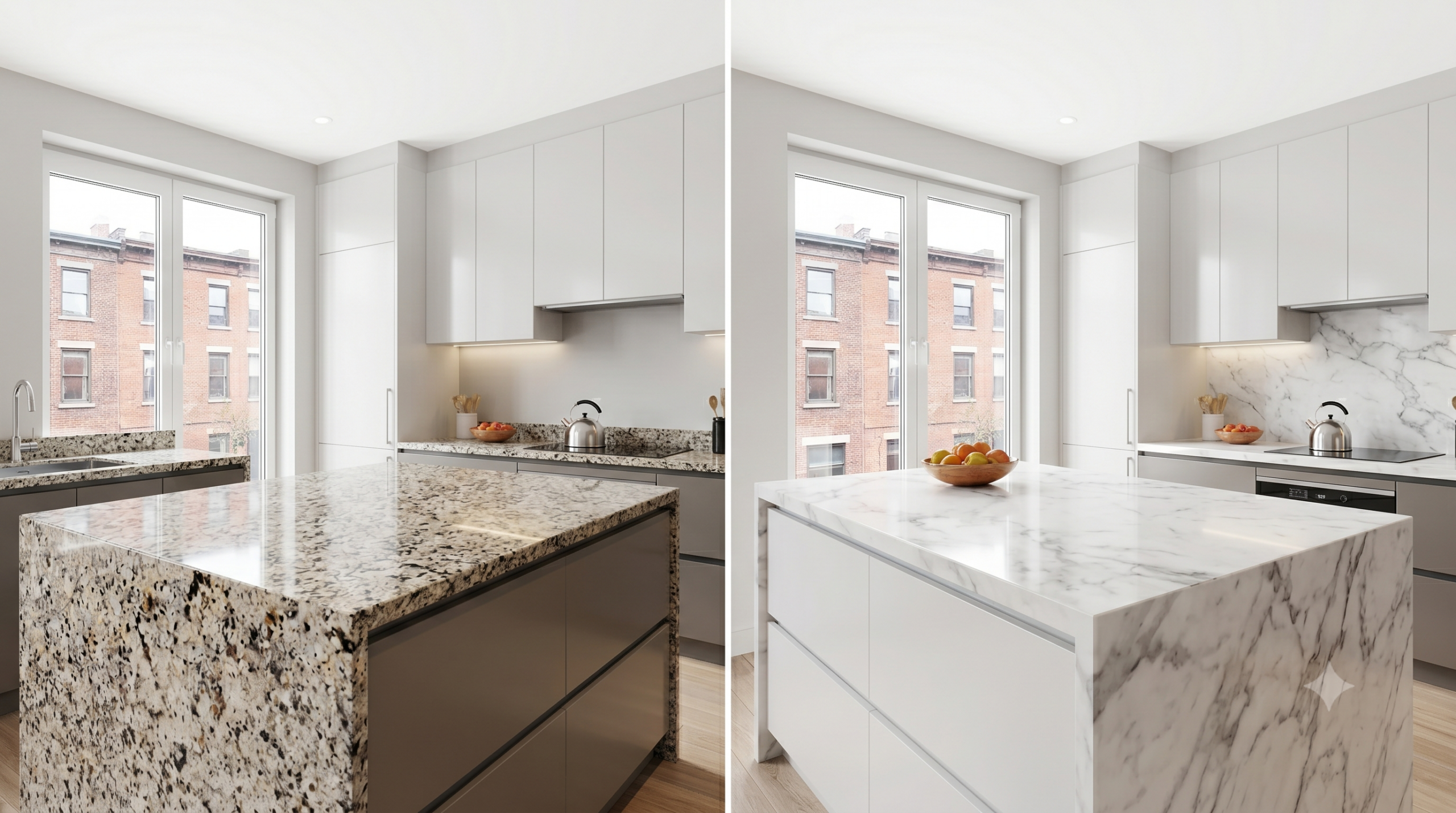
Few decisions in a kitchen renovation generate more debate than the choice between granite and marble. Both are natural stones. Both carry undeniable prestige. And both are available in Montreal in a remarkable range of colours, finishes, and price points. Yet they are fundamentally different materials, and what makes one the right choice for your kitchen may make the other the wrong one entirely.
This is not a question with a single correct answer. It is a question that depends on how you cook, how you clean, how you live, and what you actually want your kitchen to do for you. The goal of this guide is to give you the honest comparison that most showroom conversations skip, so you can make the decision with full information rather than assumptions.
At Granite Prestige, the team has been fabricating and installing natural stone countertops across Montreal since 2008. What follows reflects the kind of practical knowledge that comes from that depth of experience.
What Actually Makes Granite and Marble Different
Granite and marble are both natural stones quarried from the earth, but their geological origins, mineral compositions, and physical properties differ in ways that matter enormously in a kitchen context.
Granite: Born from Magma
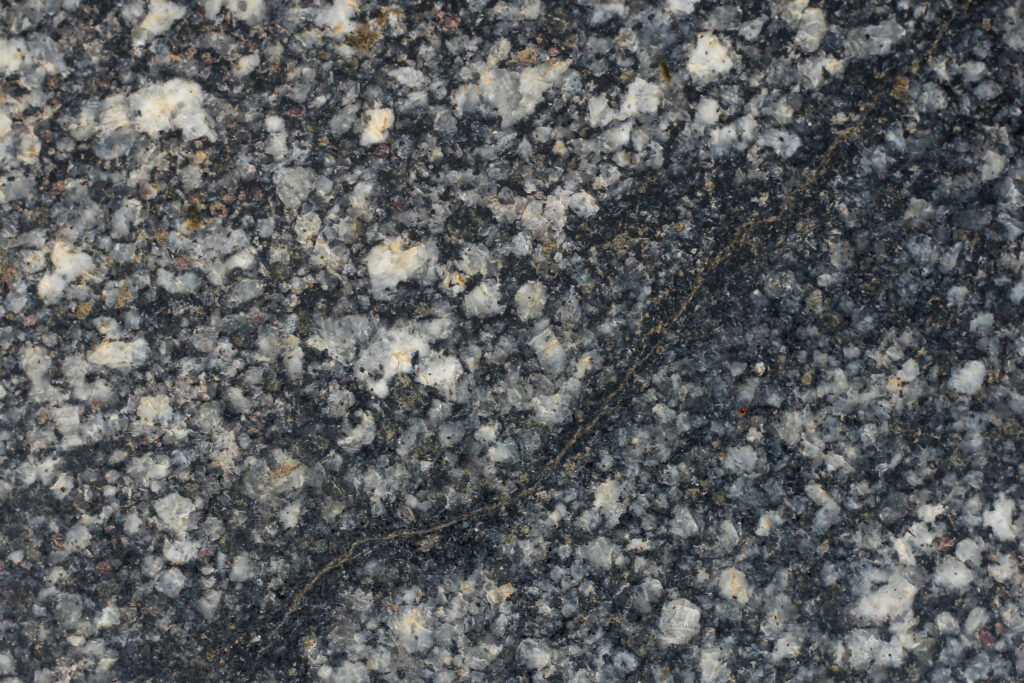
Granite is an igneous rock, meaning it formed from the slow cooling and solidification of magma deep within the earth’s crust. That process produces a dense, crystalline structure composed primarily of quartz, feldspar, and mica. The result is one of the hardest naturally occurring stones available for residential use, resistant to scratching, heat, and most forms of physical abuse a kitchen can dish out.
Its appearance is characteristically speckled or granular, with consistent patterning across the slab. Colour options range from blacks and charcoals to warm beiges, greens, blues, and whites, often with dramatic veining or movement depending on the specific variety. Because each slab comes from a natural quarry, no two pieces are identical, though the overall aesthetic family remains consistent.
Marble: Born from Limestone
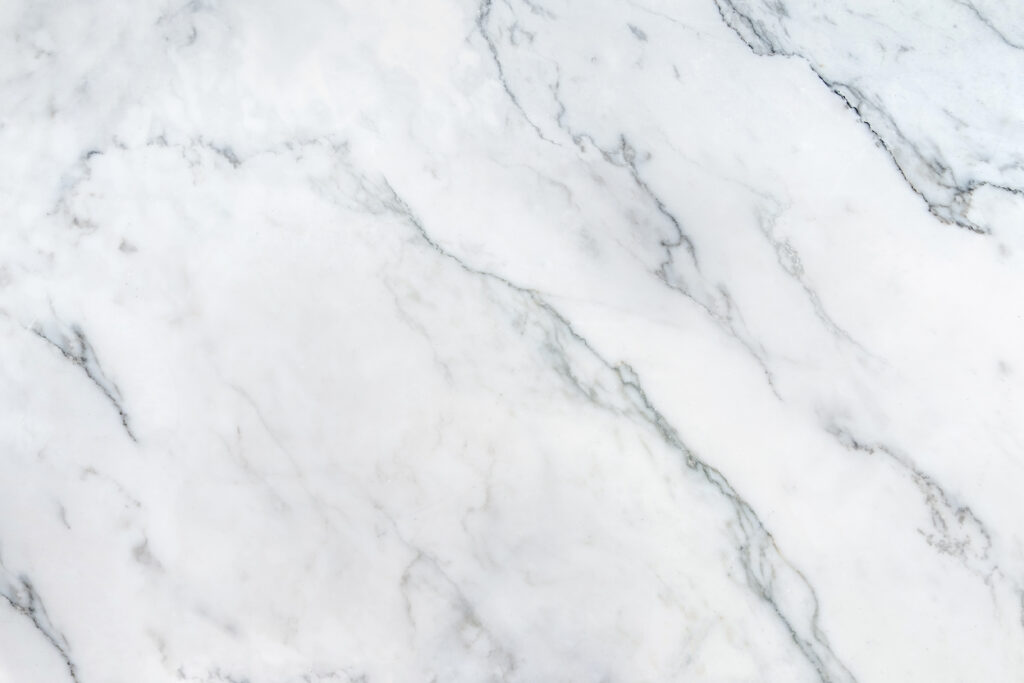
Marble is a metamorphic rock, formed when limestone is subjected to intense heat and pressure over geological time. That transformation recrystallizes the calcite in the limestone, producing the soft luminous quality and flowing veining patterns that have made marble synonymous with luxury for centuries. Carrara, Calacatta, Statuario, Emperador: each variety carries its own visual personality, and the range is extraordinary.
However, that same calcite composition that gives marble its beauty also makes it softer and more chemically reactive than granite. Marble sits at roughly 3 to 4 on the Mohs hardness scale. Granite sits at 6 to 7. That difference is not cosmetic. It defines how each stone behaves in daily use.
The Core Structural Difference
The difference between granite and marble countertops comes down to one essential distinction: granite is resistant to acid and physical damage; marble is not. Marble will etch when it contacts acidic substances (lemon juice, wine, vinegar, most cleaning products). Granite will not. That single fact shapes every practical consideration that follows.
The Honest Conversation About Marble in a Kitchen
Marble kitchen countertops is one of the most beautiful things you can install. It is also one of the most misunderstood. The honest conversation about marble begins not with a list of warnings, but with a question: what kind of kitchen is this?
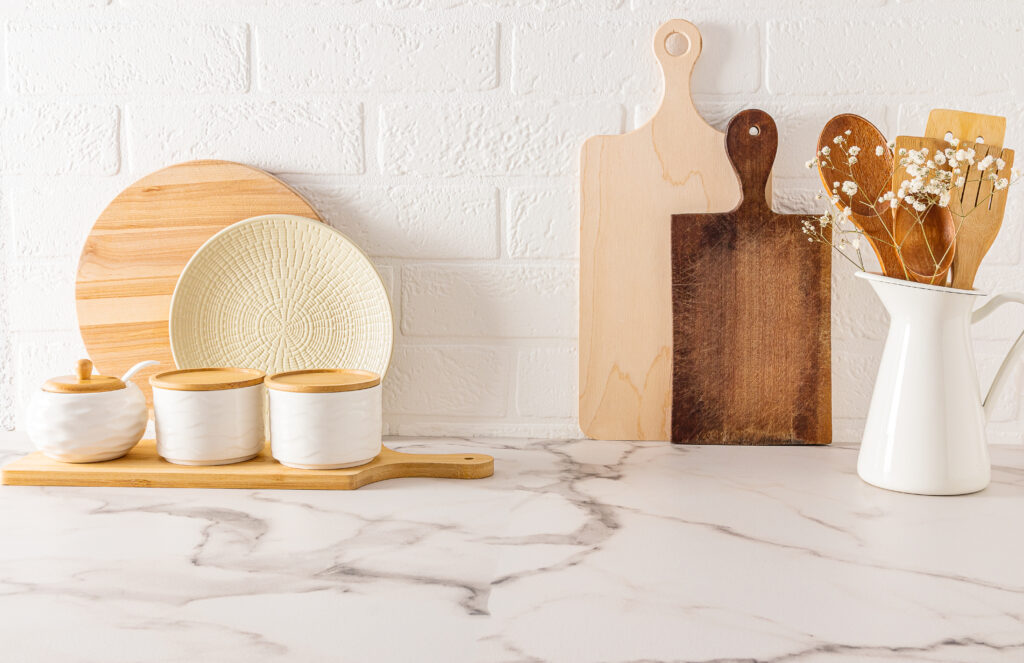
What Marble Will Do in a Working Kitchen
Marble is porous. Without regular sealing, liquids can penetrate the surface and leave stains. Even with sealing, acidic substances do not stain marble so much as they etch it. Etching is a chemical reaction between the acid and the calcium carbonate in the stone. It produces a dull, lighter mark where the polished surface has been microscopically dissolved. It cannot be wiped away. It can be honed or repolished by a professional, but in a busy kitchen, new etch marks accumulate faster than you refinish the old ones.
A squeezed lemon. A splash of tomato sauce. A glass of wine left on the counter. A vinegar-based cleaning spray used by accident. All of these will etch marble. That is not a scare tactic. It is the chemistry of the material.
Marble is also softer than granite and will scratch more easily. Cutting directly on the surface, sliding heavy pots, or even fine grit tracked in on a cutting board can leave marks over time.
Where Marble Works Well
None of this means marble does not belong in kitchens. Many of the most celebrated residential kitchens in Montreal and around the world feature marble countertops. The key is understanding where and how it works.
- Marble performs beautifully in a kitchen used with care and intention.
- It suits homeowners who are comfortable with a patina developing over time, who see the marks of use as character rather than damage.
- Honed marble (matte finish) shows etching less visibly than polished marble, making it a more practical choice for kitchen surfaces.
- Marble is exceptional for baking zones, where its naturally cool surface is a functional advantage for pastry work.
- As an island surface that doubles as a display or a secondary prep area, marble can be striking and entirely manageable.
The Maintenance Reality in Montreal
Montreal homeowners should factor in the local context. The city’s food culture is rich and acidic-ingredient-heavy. Maple syrup, wine, citrus, aged cheeses, vinaigrettes: a Montreal kitchen is an active one. Marble kitchen maintenance in Montreal requires a consistent sealing schedule (at minimum once or twice a year), prompt cleanup of anything acidic, and a genuine acceptance of the material’s living quality.
For some homeowners, that care is entirely worth it. For others, it is a source of daily anxiety. Knowing which camp you are in before you commit to marble is the most important research you can do.
Granite’s Real Strengths, And Its Honest Limitations
Granite kitchen countertops has earned its reputation as the workhorse of natural stone countertops, and that reputation is largely deserved. But an honest assessment means acknowledging both what it does well and where it falls short.
What Granite Does Exceptionally Well
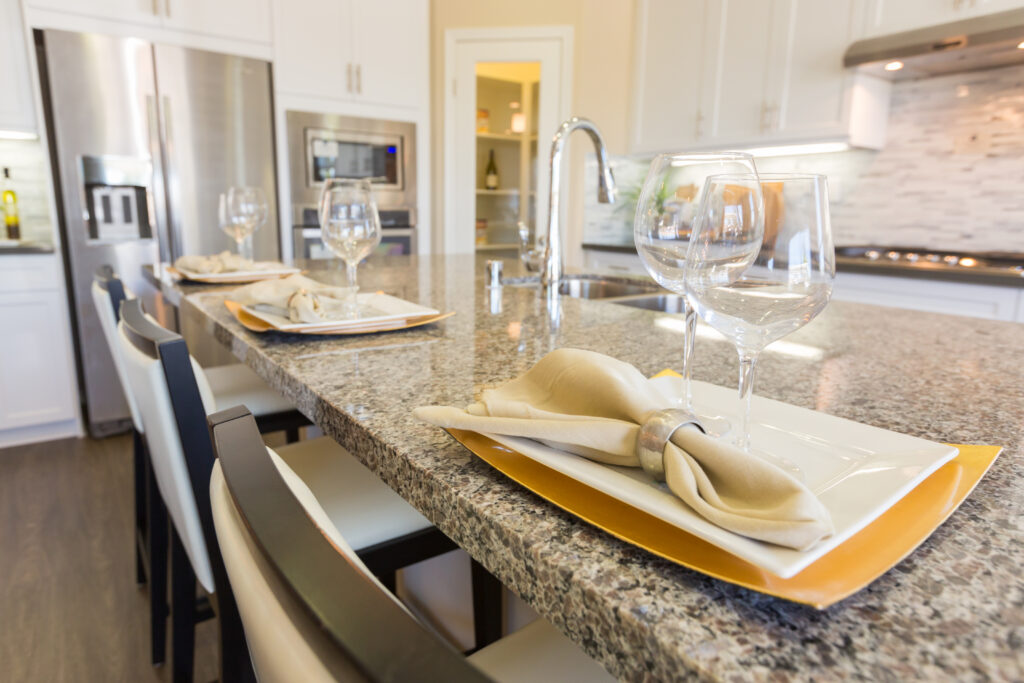
Hardness is granite’s primary advantage. At 6 to 7 on the Mohs scale, it resists scratching from knives, pots, and daily kitchen activity far better than marble or most engineered alternatives. You can slide cast iron across granite without concern. You can place a hot pan directly on the surface without damaging it. That kind of resilience, over years of daily use, is genuinely valuable.
Granite is also naturally resistant to acids. A splash of lemon juice, a glass of red wine, a tomato-based sauce: none of these will chemically alter the surface of a sealed granite counter the way they would marble. This is a significant practical advantage for Montreal kitchens where cooking is taken seriously.
Porosity is lower in granite than in marble, which means it seals more effectively and resists staining more durably. A properly sealed granite countertop requires resealing less frequently than marble and is more forgiving of the inevitable lapses in maintenance that come with a busy household.
The aesthetic range of granite is also frequently underestimated. Beyond the conventional beige-and-black options of earlier decades, today’s granite selection at a well-stocked Montreal supplier includes deep forest greens, dramatic blues, warm cognac tones, and near-white slabs with subtle silver movement that can rival marble visually from a distance.
Where Granite Has Limitations
Granite’s primary aesthetic limitation is that it does not replicate the soft luminosity or the flowing, organic veining of marble. The two materials look different. If the design vision for a kitchen specifically requires that marble quality of light and movement, granite is not a substitute.
The speckled, granular pattern of most granites can also be harder to integrate into minimalist or monochromatic design schemes that rely on a clean, uninterrupted surface. This is a design consideration, not a deficiency, but it matters in the context of a specific kitchen vision.
Weight and cost vary by variety. Some exotic granite slabs command pricing comparable to high-end marble. The assumption that granite is always the economical option is outdated.
Head-to-Head, The Practical Comparison
A direct side-by-side comparison of granite and marble across the dimensions that matter most in a kitchen:
Durability
Granite wins clearly. It is harder, less reactive to acids, and more resistant to scratching and chipping in daily kitchen use. Marble requires more protection and will show wear in an active kitchen faster than granite.
Maintenance
Granite is significantly easier to maintain. Both stones require periodic sealing, but granite is more forgiving of delayed sealing, more resistant to the common substances encountered in cooking, and less prone to the etching that makes marble maintenance a continuous commitment.
Aesthetics
This is where marble’s case is strongest. The luminosity, depth, and flowing veining of natural marble is distinctive and difficult to replicate in any other material. For certain design visions, particularly bright, airy kitchens with a European or classical sensibility, marble’s visual quality is irreplaceable. Granite offers beauty and visual character, but of a different and more subdued kind.
Cost
Both materials vary widely by variety and origin. Entry-level granite is generally more accessible in price than mid-range marble. However, premium granite and premium marble occupy similar price territory. The assumption that granite is always cheaper is not reliable; compare specific slabs rather than categories.
Resale Value
Both materials are valued positively in the Montreal real estate market. Natural stone countertops, whether granite or marble, signal quality and permanence to buyers. Neither choice represents a liability at resale, though the condition of marble at the time of sale will matter more, since an etched or stained marble surface is visible and can affect buyer perception.
Longevity
Both stones last for decades when properly maintained. Granite is more forgiving of imperfect maintenance. Marble, well cared for, develops a beautiful patina; poorly cared for, it can show significant wear within years. The difference in longevity comes down more to care than to inherent material quality.
When to Choose Each, By Kitchen Type and Lifestyle
Choose Granite If…
- Your kitchen is your household’s command centre, used heavily every day for serious cooking.
- You have children or a household pattern that makes spills, forgotten cleanup, and surface contact with acidic foods inevitable.
- You want a surface that requires minimal vigilance to maintain its appearance over years.
- Your design vision calls for warmth, depth, and natural character without requiring the specific visual quality of marble.
- You are renovating a rental property or a kitchen where long-term low maintenance is a priority.
- You want confidence placing hot pots, working with citrus and wine, and not thinking twice about what touches the counter.
Choose Marble If…
- Your kitchen is used with care and intention, and you are willing to maintain the surface according to what the material requires.
- The design vision for your space specifically calls for marble’s luminosity, veining, and visual depth.
- You are creating a showpiece kitchen where aesthetics are the primary priority.
- You are comfortable with the idea of patina: marks of use that accumulate into character over time.
- You are installing a dedicated baking zone or island where marble’s cool surface is a functional and visual asset.
- You understand the material’s requirements before you commit, not after.
The Middle Path: Strategic Material Placement
Many of the most successful kitchen renovations in Montreal use both materials in a single space. Granite on the perimeter counters (where the majority of heavy cooking, prep, and daily activity happens) and marble on the island (where it can be the visual centrepiece of the room while being somewhat protected from the most intensive kitchen use). This approach captures the durability benefits of granite and the aesthetic benefits of marble without asking either material to perform outside its strengths.
Granite Prestige’s team can help you explore this kind of combined approach with specific slab options from their selection of both materials.
Montreal-Specific Considerations
Montreal is not a generic market, and the choice between granite and marble in a Montreal kitchen is shaped by factors specific to this city.
Climate and Thermal Performance
Montreal’s temperature range, from humid summers that push 35 degrees to winters that drop well below minus 20, creates a challenging environment for any building material. Natural stone handles this range well as a countertop material, since it is installed in a climate-controlled interior. However, both granite and marble expand and contract slightly with temperature changes. This is managed through proper fabrication and installation, and a qualified fabricator like Granite Prestige will account for it. Neither stone is a poor choice on thermal grounds in a Montreal kitchen.
The Montreal Food Culture Factor
Montreal’s cooking culture is distinctive. It is a city that eats and cooks seriously, where kitchens are often multi-purpose spaces used for everyday family cooking, entertaining, and the kind of extended meal preparation that defines Quebec hospitality. That cooking profile, heavy in acidic ingredients, wine, citrus, and bold flavours, tilts the practical calculus toward granite in kitchens where the surface will be fully exposed to cooking activity. The question is not whether you can use marble in a Montreal kitchen. Many homeowners do, successfully. The question is whether your kitchen’s usage pattern matches what marble requires.
Real Estate Context
Montreal’s real estate market, particularly in NDG, Westmount, Outremont, the Plateau, and the South Shore communities, places a genuine premium on kitchen quality. Natural stone countertops, of either variety, are consistently valued positively by buyers. The more relevant consideration at resale is condition. A granite counter that has aged well over ten years is an asset. A marble counter that has accumulated significant etching or staining is a conversation. Choosing a material you can maintain properly is, in a real estate sense, also the financially sound choice.
Local Sourcing and Fabrication
Working with a Montreal-based fabricator matters more than is often acknowledged. A local shop like Granite Prestige, which has been operating from its Ville Saint-Laurent location since 2008 and fabricates on-site, can show you actual slabs rather than samples, fabricate to the precise dimensions and edge profiles your kitchen requires, and provide installation by a team that understands the conditions of Montreal homes. Countertop decisions made through a local expert are less likely to produce the surprises that come from purchasing stone through remote channels.
Conclusion
The granite vs. marble kitchen debate does not have a universal answer. It has a correct answer for your kitchen, your lifestyle, and your design vision, if you have the right information to find it.
Granite offers hardness, acid resistance, and low-maintenance durability that make it the more practical choice for most active Montreal kitchens. Marble offers visual beauty, luminosity, and a certain irreplaceable quality that no other material fully replicates, but it asks for care in return.
The strongest kitchens are not built on a single correct material. They are built on the right material in the right place, chosen with honest knowledge of what each stone does well and what it requires.