Montreal kitchens take a beating most countertop materials were never built for. Winters swing from wet thaws to bone-dry cold snaps. Humidity creeps into every crack a surface will give it. And then a busy household piles on hot pans, red wine, and the occasional dropped cast iron pot. When homeowners get down to porcelain versus quartz, the question usually isn’t which one is “better.” It’s which one fits how you actually use your kitchen.
Both materials have taken off over the past decade, and both can look genuinely stunning in a Montreal kitchen or bathroom. But they behave differently under heat, under a knife, and under the freeze-thaw punishment of a Quebec winter if either one ends up outside. Here’s what actually separates them, so you walk into a showroom already knowing what to ask.
What Each Material Actually Is
Quartz is engineered, not mined. Manufacturers grind up natural quartz crystal, roughly 90 to 94 percent of the slab, and bind it with polyester resins and pigments under heat and pressure. You end up with a dense, non-porous surface where the colour and pattern stay consistent from edge to edge.
Porcelain starts life as clay, feldspar, and mineral pigments, pressed into slabs and fired at brutal temperatures, often north of 1,200 degrees Celsius. That firing is what gives porcelain its two defining traits: it barely absorbs heat or moisture, and it’s hard enough to rival natural stone. Think of it as tile’s big sibling, scaled up into full slab format.
That manufacturing gap explains almost everything else here. It’s why one shrugs off a hot pan and the other doesn’t, and why one can live outside through a Montreal winter while the other really shouldn’t.
Heat Resistance Is the Big One
For most Montreal homeowners, this ends up deciding the whole thing. Porcelain, thanks to that high-heat firing, is basically heat-proof. A pan straight off the stove, a cast iron skillet, even a pizza stone fresh from a 260-degree oven, you can set it right on porcelain with no trivet and no worry about scorching or cracking.
Quartz can’t say the same. The resin holding it together doesn’t love heat, and manufacturers are blunt about it: trivets and hot pads aren’t optional. Sustained heat above roughly 150 degrees Celsius can scorch that resin, leaving a permanent mark, or worse, cracking the surface outright. If you cook a lot, especially with cast iron, this one factor might settle the whole decision.
Hardness, Scratching, and Edge Durability
Both materials are hard. Both shrug off the everyday abuse of a working kitchen far better than laminate or butcher block ever could. But they don’t behave identically under stress. Porcelain typically lands around 6 to 7 on the Mohs scale and, thanks to its dense fired structure, resists scratching and acid etching remarkably well. It also holds up under UV, which matters if your counter sits near a sunny window or lives outdoors.
Quartz sits in a similar hardness range and handles knife contact just as well day to day. Where they split is at the edges. Porcelain slabs, especially the thinner 12 to 13 millimetre formats used for waterfall edges, can chip more easily at a corner if something heavy lands square on it, a dropped cast iron pot, say. Quartz, being a denser resin-bound composite, tends to absorb that kind of hit slightly better. Neither one is invincible against a hard enough drop.
Where Each Material Wins on Looks
Quartz’s real strength is consistency and range. Because it’s engineered, manufacturers can dial in almost any colour, from stark white to deep charcoal to veining that mimics Calacatta marble, and that look repeats reliably across the whole slab and matches cleanly across multiple slabs on a bigger job.
Porcelain has closed the gap fast. High-definition printing now reproduces marble veining, concrete texture, even wood grain convincingly enough that it’s tough to tell from natural stone up close, and you can get it in matte, polished, or textured finishes. It also comes in extra-large formats, which means fewer seams running across a big island, a real win for the open-concept kitchens so common in Montreal.
Maintenance: The Day-to-Day Reality
Quartz is famously low-fuss because it comes non-porous out of the factory. No sealing, ever. Daily cleaning is just warm water and mild soap, and it shrugs off wine, coffee, and oil without much effort on your part.
Porcelain is the same story once it’s fired: non-porous, no sealing needed, easy daily upkeep. It resists staining, mould, and bacteria just as well as quartz, and it won’t develop the faint yellowing some quartz surfaces pick up after years in the sun. Honestly, the maintenance gap between the two is small enough that it rarely decides anything on its own, though porcelain has a slight edge in sun-heavy spots or where acidic ingredients get prepped often.
Outdoor Use: Montreal’s Climate Settles This One
Here’s where the comparison isn’t close anymore. Montreal’s climate, freeze-thaw cycles, road salt, summer UV, humidity swings every spring and fall, is genuinely rough on outdoor surfaces. And this is the category where porcelain pulls decisively ahead.
Porcelain is frost-resistant and barely absorbs moisture, so it won’t crack under freeze-thaw the way a more porous or resin-bound material can. That’s exactly why it’s become the go-to for outdoor kitchens, covered patios, and BBQ islands around here, it holds its colour and structure through a full Quebec winter outside.
Quartz just isn’t built for that. The same resin that makes it durable indoors breaks down under prolonged UV, fading over time, and the material isn’t rated to survive freeze-thaw stress in an unheated outdoor space through a Quebec winter. If there’s an outdoor kitchen in your plans, porcelain is the clear call.
What the 2026 Montreal Market Looks Like
Pricing for both moves around based on slab quality, thickness, edge profile, and how complicated the fabrication is, so treat any number here as a planning range, not a quote. Through 2026 in Montreal, mid-range quartz still tends to run a bit less per square foot installed than premium porcelain, though that gap has narrowed as more fabricators locally get set up to work with porcelain.
Porcelain can carry a modest premium in some jobs simply because cutting and finishing it takes specialized tooling, especially for mitred waterfall edges or large-format slabs. Both sit comfortably above laminate and below high-end natural stone like exotic marble. If you want a real number, get a slab-specific quote, since square footage, edge style, and sink or cooktop cutouts all move the final price more than people expect.
Which One Fits Your Montreal Home
A few quick questions usually settle it. If heat resistance matters most to you, if there’s an outdoor kitchen or patio bar somewhere in the plan, or if your household cooks a lot with cast iron straight off the stove, porcelain is probably the better fit. If you’d rather have a wider range of engineered colours, a slightly lower cost per square foot, or a bit more edge toughness on a busy island corner, quartz is still a proven, excellent choice.
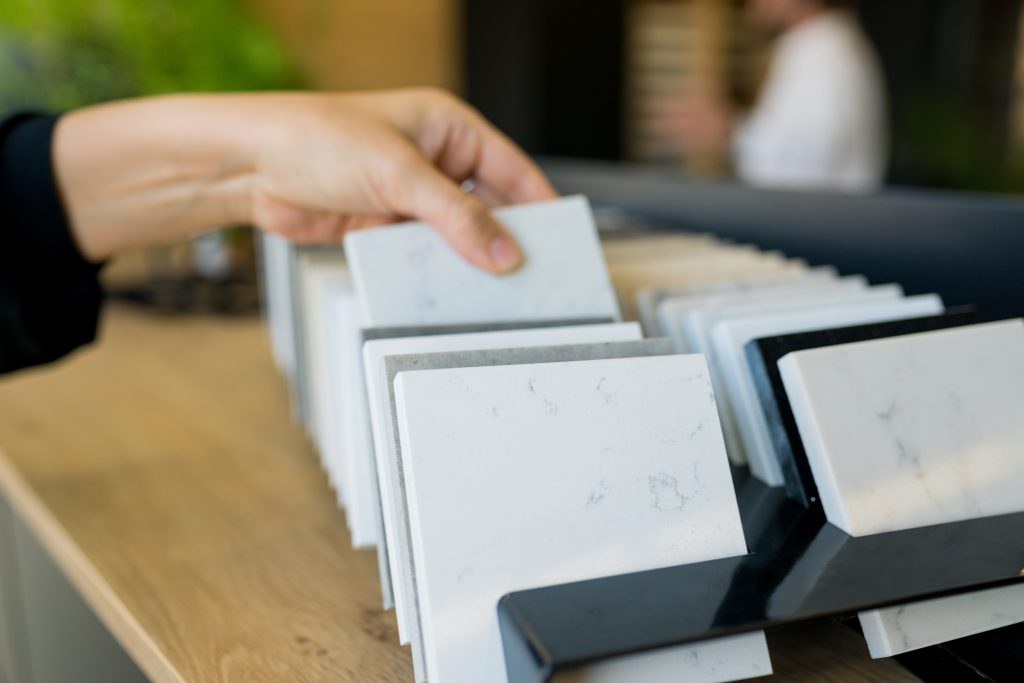
Plenty of Montreal homeowners end up splitting the difference: quartz on the main kitchen island, porcelain out on the patio or on a sun-facing bathroom vanity. And honestly, seeing both in person, under the lighting your kitchen actually has, next to your real cabinet samples, beats any photo for making the final call.
Conclusion
Porcelain and quartz both hold up beautifully in a Montreal home, but they’re not interchangeable. Porcelain takes the win on heat resistance and outdoor durability. Quartz takes it on colour range, edge toughness, and typical cost. Both are easy to live with day to day. The right pick has less to do with which material wins on paper and more to do with how your kitchen actually gets used, and how much of that use happens outside a Quebec winter’s reach.
Granite Prestige has walked Montreal and North Shore homeowners through exactly this decision since 2008. Come see porcelain and quartz slabs side by side in the showroom, under real lighting, and you’ll go from researching to deciding a lot faster than you’d think.